

Paper Review: Towards a Science of Scaling Agent Systems (arXiv:2512.08296)

Why throwing more agents at a sequential reasoning problem degrades accuracy, and what topology rules actually hold up in production.
1. Why This Paper Matters Now
For the last two years, the default response to an underperforming LLM workflow has been to add more agents. If a single prompt fails to write and verify a complex SQL migration, engineers split the task into a Planner, a Coder, a Critic, and a Summarizer. We treat multi-agent orchestration like horizontal compute scaling: if one node is slow or unreliable, throw five nodes at the problem and put a load balancer in front of them.
Anyone running these graphs in production knows this analogy fails. In distributed systems, adding stateless worker nodes increases throughput. In multi-agent LLM systems, adding nodes often increases cost and latency while actively degrading accuracy. You end up debugging a distributed game of telephone where one agent's minor hallucination becomes the next agent's ground truth.
Google Research's December 2025 paper, Towards a Science of Scaling Agent Systems, is one of the first rigorous attempts to replace agent folklore with empirical scaling laws. Instead of proposing yet another cute multi-agent framework, the authors evaluate how different agent topologies actually perform under fixed compute and token budgets across diverse task structures. If you are tired of guessing whether your workflow needs a hierarchical supervisor or a single loop with better tools, this paper provides the math and the measurements to make that call.
2. The Core Idea in Plain English
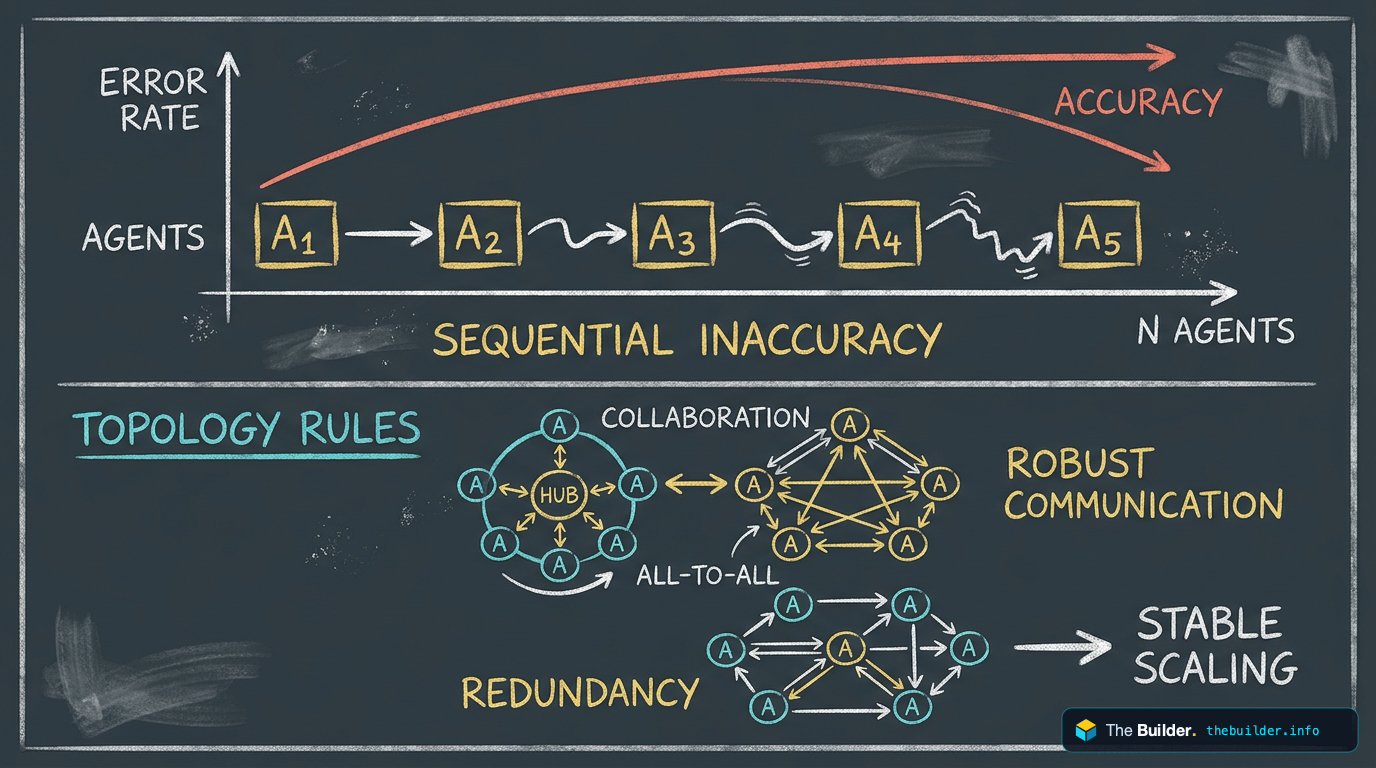
The central thesis of the paper is that multi-agent scaling is governed by the decomposition structure of the underlying task, not the raw number of agents. The authors categorize tasks along two primary axes: Parallelizability (can sub-problems be solved independently without sharing intermediate state?) and Sequential Depth (does step $N$ strictly depend on the exact output of step $N-1$?).
When you scale an agent system, you trade off generation diversity against coordination tax. Every boundary between two agents is a lossy compression channel. When Agent A hands off work to Agent B, Agent B either receives a truncated summary (losing implicit context) or receives the entire raw scratchpad (polluting its context window with irrelevant reasoning tokens).
[Task: High Sequential Depth]
Agent 1 ---> (Lossy Handoff) ---> Agent 2 ---> (Lossy Handoff) ---> Agent 3
Result: Compounding drift. Single-agent + deterministic tools wins.

[Task: High Parallelizability]
         +---> Worker Agent A (Sub-task 1) ---+
Router --+---> Worker Agent B (Sub-task 2) ---+--> Verifier / Merger
         +---> Worker Agent C (Sub-task 3) ---+
Result: Sub-linear latency, higher recall. Multi-agent wins.
Stripping away the formal notation, the authors demonstrate three empirical findings:
Sequential chains degrade with scale: On tasks requiring deep sequential reasoning (like multi-step mathematical proofs or stateful code refactoring), adding specialized handoff agents reduces success rates compared to a single strong model given the same total token budget. The error rate compounds multiplicatively across agent boundaries.
Parallel breadth scales cleanly, if verification is cheap: When a task can be cleanly partitioned (such as auditing ten independent microservices or generating candidate hypotheses), fan-out topologies scale well. However, this only holds if the final aggregation step relies on a deterministic check (like a compiler or test suite) or a low-complexity comparison.
Communication topology matters more than persona: Giving agents elaborate role prompts ("You are a world-class security auditor") yields negligible gains compared to restricting the graph topology so agents only share structured, schema-validated state.
3. Where the Assumptions Hold vs. Break in Production
The paper's cleanest insight is normalizing comparisons by total token budget. In many academic papers, a five-agent system beats a single agent simply because the five-agent system consumed 5x the compute. By holding compute constant, the authors prove that a single agent given five retries with environment feedback frequently outperforms a five-agent debate committee.
In production, this holds up remarkably well. State serialization across agent boundaries is where reliability goes to die. Every time you serialize an agent's internal state into natural language for another agent to read, you introduce parsing ambiguity.
However, the paper makes a few laboratory assumptions that break when you put real traffic on the system:
The Uniform Latency Assumption: The authors measure cost primarily in tokens and steps. In production systems, we care about tail latency (p99). A sequential three-agent chain doesn't just multiply error rates; it adds the p99 latency of three separate network calls and prompt-processing phases. Conversely, a wide parallel fan-out (say, 15 sub-agents) is bottlenecked by the slowest single straggler. Without aggressive hedged requests and timeouts, wide agent topologies exhibit terrible tail latency.
Clean Tool Idempotency: The paper evaluates tasks where the environment is largely static or resettable (coding benchmarks, QA datasets). In production workflows that mutate external state via APIs, you cannot simply run five parallel agents to explore different branches and pick the best output. Once an agent calls an external webhook or writes a database row, rolling back the losing branches requires complex saga patterns that the paper glosses over.
Context Window Economics: While a single agent with a massive context window beats a multi-agent chain on sequential accuracy, KV-cache pricing and time-to-first-token (TTFT) degrade non-linearly as context grows. Sometimes we split a sequential task into two agents in production not because it is smarter, but because dropping 80,000 tokens of dead tool outputs is the only way to keep TTFT under two seconds.
4. One Thing I Would Steal (or Test This Weekend)
If you have a multi-agent workflow in staging or production right now, steal the paper's Compute-Normalized Ablation Test.
Take your current multi-agent graph (for example, a 3-agent Planner -> Executor -> Critic pipeline) and measure the average total tokens and wall-clock time it consumes per run. Then, build a baseline consisting of a single agent loop using the exact same underlying model, given the union of all tools and a hard budget equal to that exact token count. Instead of passing state to a "Critic" agent, wire the deterministic validation checks directly into the single agent's tool execution feedback.
Run 100 real payloads through both. The paper's data suggests that if your task has high sequential interdependence, the single-agent loop will beat your multi-agent graph on both accuracy and p95 latency, while allowing you to delete hundreds of lines of orchestration glue code.
Only introduce a second agent boundary when you need strict privilege separation (Agent A has read-only prod access; Agent B has write access to a staging branch) or when you can run the agents completely in parallel without shared mutable state.
5. Citation & Primary Link
Paper: Towards a Science of Scaling Agent Systems (Google Research, Dec 2025)
Primary Link: https://arxiv.org/pdf/2512.08296.pdf
***
A question for peers building with agents: When you decompose a workflow into multiple agents today, how often is that boundary driven by genuine task parallelism versus working around context-window rot and prompt complexity?


Comments