

Paper Review: The Tail at Scale and Metastable Failures

Why retry storms and unbounded queues turn tiny latency blips into self-sustaining outages.
1. Why This Paper Matters Now
Most distributed systems outages do not start with a dead data center. They start with a 200-millisecond garbage collection pause, a noisy neighbor on a shared hypervisor, or a brief network flap. Five minutes later, the trigger is gone, the underlying hardware is healthy, and yet the cluster remains completely wedged at 100% CPU utilization, serving zero successful requests.
Understanding why this happens requires reading two canonical pieces of systems literature together: Jeffrey Dean and Luiz André Barroso's 2013 paper The Tail at Scale, and the more recent body of work on metastable failures in distributed systems (heavily popularized and expanded upon by Marc Brooker).
Dean and Barroso gave us the vocabulary and techniques to hide tail latency in large fan-out systems, such as hedged requests and tied retries. Those techniques work brilliantly when you have abundant spare capacity. However, when a system operates near its utilization limits, the exact mechanisms we use to mask tail latency become the primary fuel for metastable failure modes. If you build microservices, manage connection pools, or configure retry policies in RPC frameworks, pairing these two perspectives explains why your system refuses to heal itself after a minor transient spike.
2. The Core Idea in Plain English
Queueing theory tells us a simple truth: as a server approaches 100% utilization, the time a request spends waiting in line grows exponentially.
In The Tail at Scale, the core observation is that when a user request fans out to dozens of backend nodes, the overall response time is dictated by the slowest single node. If one node is experiencing a brief latency spike, the whole request is slow. The obvious engineering fix is to be impatient. If a backend does not respond within the 95th percentile latency window, the client fires a second, duplicate request (a hedged request or a retry) to another node.
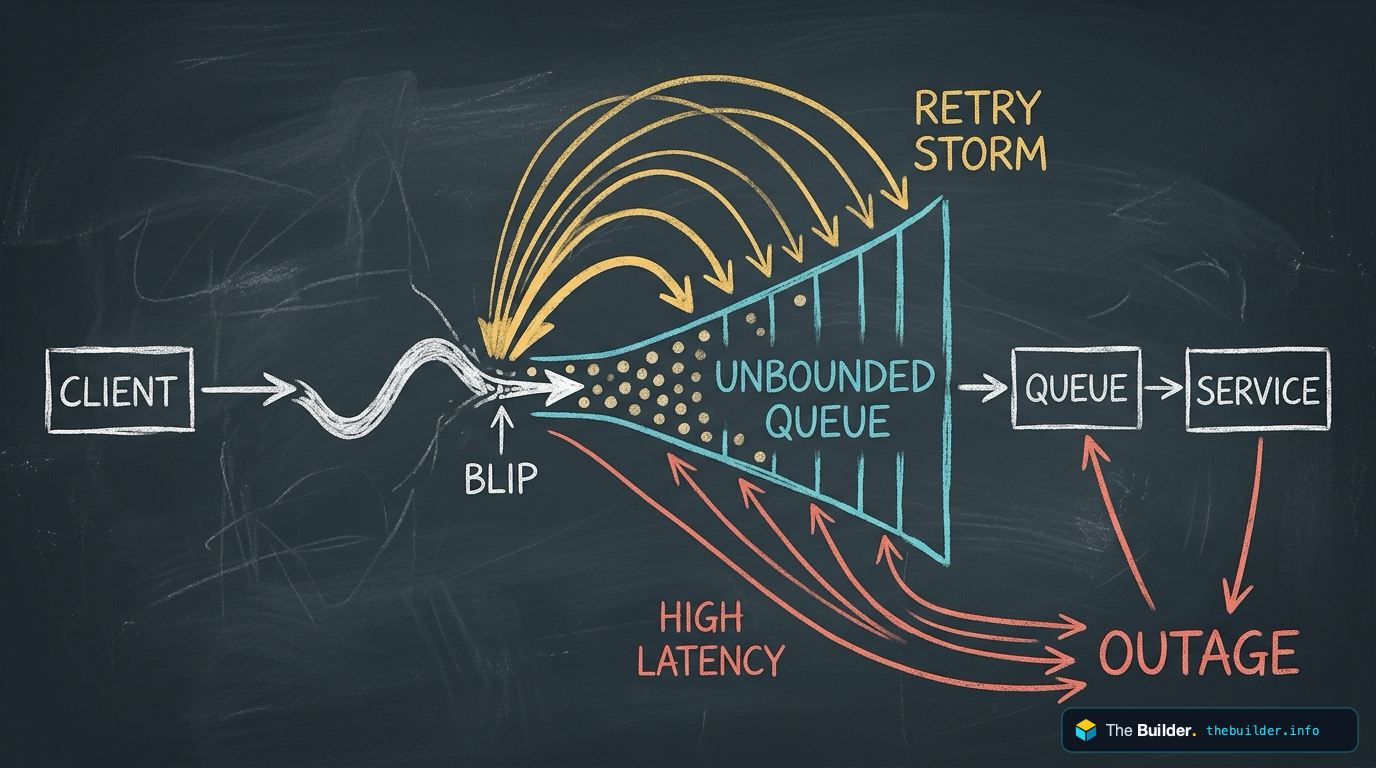
Here is where metastability enters the picture. A metastable failure occurs when a temporary trigger pushes a system into a bad state, and a feedback loop keeps the system trapped in that bad state even after the trigger disappears.
[Transient Blip]
       |
       v
+--> [Queueing Delay Increases]
|      |
|      v
|    [Clients Timeout & Retry]
|      |
|      v
|    [Total Offered Load Multiplies]
|      |
|      v
+--- [Goodput Drops / CPU Spent on Dead Work]
Walk through the mechanics of that loop without any Greek notation:
The Normal State: Your service handles 1,000 requests per second (RPS) comfortably at 60% CPU utilization.
The Trigger: A brief network blip delays responses by 500ms.
The Amplification: Clients hit their 300ms timeout and retry. Suddenly, the server is receiving 2,000 RPS (1,000 new requests + 1,000 retries).
The Trap (Work Amplification): The server is now past 100% capacity. Its internal queues fill up. Because requests sit in the queue for so long, by the time the server actually pulls a request off the queue, deserializes it, queries the database, and computes the answer, the client has already timed out and walked away.
The server is burning all of its CPU cycles doing useless work for departed clients, which delays the newer requests waiting in the queue, which causes those clients to retry. Even if the network blip healed ten minutes ago, the retry loop sustains itself indefinitely. To recover, you do not need to fix the network; you have to break the feedback loop by shedding load below the server's bad-state throughput capacity.
3. Where the Assumptions Hold vs. Break in Production
The techniques in The Tail at Scale hold up exceptionally well under two strict assumptions: stateless read paths and strictly bounded retry budgets.
When Google popularized hedged requests, they did so largely in the context of read-only search indexes where an extra read costs a fraction of a millisecond of CPU and mutates no state. Furthermore, if you only hedge the slowest 5% of requests, you only increase total cluster load by 5%. Under normal operating conditions, trading 5% extra compute for a massive reduction in p99 latency is a great bargain.
In standard production architectures, these assumptions break along three fault lines:
Uncoordinated Retries Across Layers: Modern architectures rarely have a single fan-out layer. An API gateway retries a service, which retries an internal client, which retries a database driver. If each of the three layers is configured for 3 retries, a single slow database query gets amplified into $3^3 = 27$ queries. Your 5% overhead becomes a 2,700% traffic spike.
Lock Contention and State Boundaries: You cannot safely hedge or aggressively retry mutating requests without rock-solid idempotency keys. Worse, when retries hit a relational database, they do not just burn CPU; they hold row locks and connections. A timed-out HTTP request often leaves its underlying database transaction running in the background, starving incoming retries of connection pool slots.
Unbounded In-Memory Queues: Many default thread pools and async runtimes use unbounded queues. When latency spikes, memory fills with thousands of waiting requests. This triggers garbage collection thrashing, which slows down request processing even further, deepening the metastable trap.
4. One Thing I Would Steal (or Test This Weekend)
If you want to immunize a service against retry-driven metastability this weekend, steal the combination of Token-Bucket Retry Budgets and Deadline Propagation (combined with LIFO shedding).
First, ban unconditional per-request retries (e.g., max_retries = 3). Instead, implement a client-side token bucket per process. Every time a client sends a normal request, it puts 0.1 tokens into the bucket (up to a cap of, say, 50 tokens). Every time a client wants to retry a failed or slow request, it must spend 1 full token. If the bucket is empty, the retry is blocked and the error returns immediately. This mathematically guarantees that retries can never increase your backend load by more than 10%, completely neutralizing the retry storm loop during a generalized outage while still masking isolated single-node blips.
Second, pair this with server-side deadline checking. Have the client attach an absolute timestamp (X-Deadline-At) or a remaining time budget to the request header. Before your server pulls a task off its internal queue or initiates an expensive database call, check the clock. If the deadline has already passed, drop the request on the floor immediately without doing the work.
5. Citation & Primary Link
Foundational Paper: Jeffrey Dean and Luiz André Barroso, "The Tail at Scale", Communications of the ACM, Vol. 56 No. 2 (2013).
Practitioner Synthesis on Metastability & Retries: Marc Brooker's extensive writing on queueing, retries, and metastable failures can be found directly at https://brooker.co.za/blog/.
Question for peers: When you audit your production RPC clients today, are your retry policies bounded by a global ratio (like a token bucket), or are they still configured as a static integer per request?


Comments