

Paper Review: Deterministic Simulation Testing in Distributed Systems

How FoundationDB and TigerBeetle catch the 1% tail bugs that unit tests and staging clusters never reproduce.
1. Why This Paper Matters Now
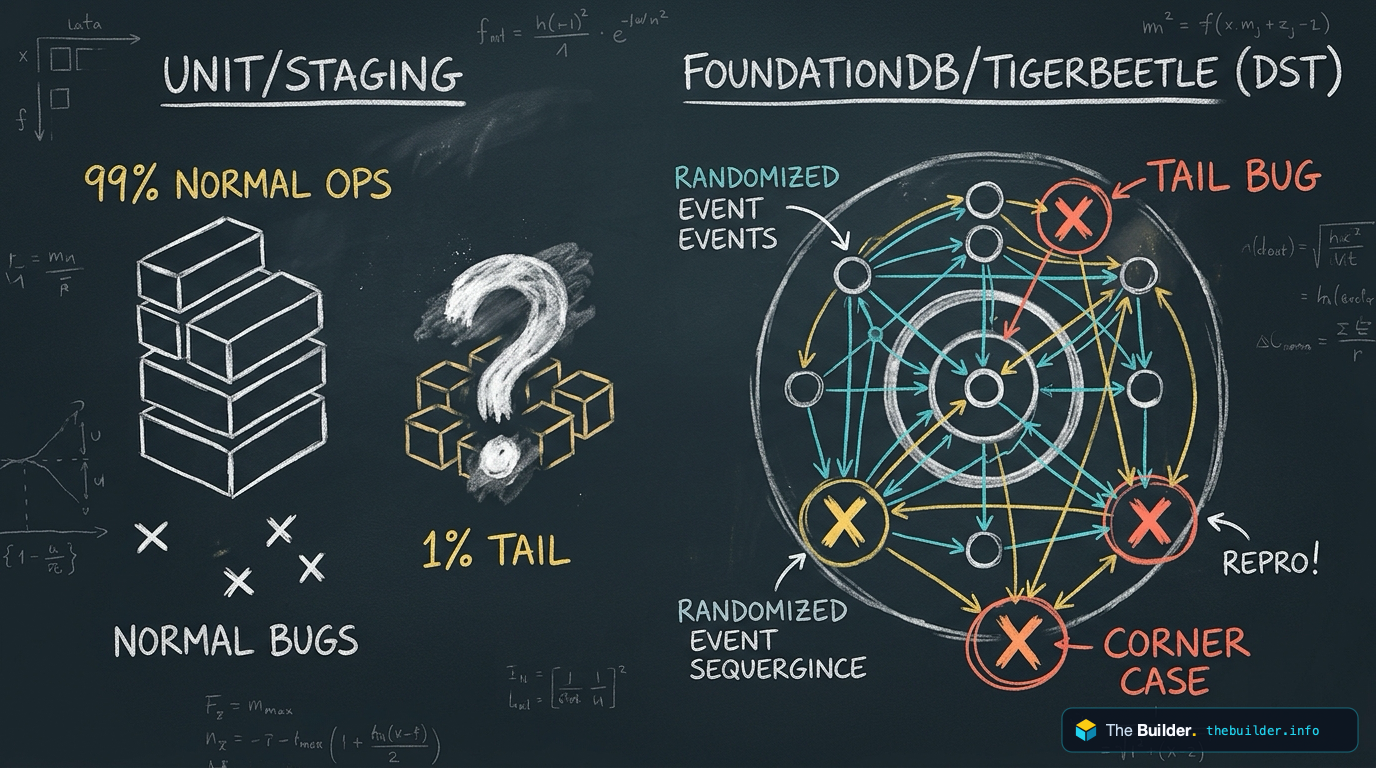
Every distributed systems engineer eventually hits the same wall. You build a replication protocol or a distributed state machine. You write unit tests, integration tests, and Jepsen-style chaos suites. Everything passes. Then you deploy to production, and three months later at 3:00 AM, a combination of a slow disk write, an asymmetric network partition, and a leader election timeout corrupts state.
You cannot reproduce the failure locally because it relies on a specific, microsecond-level interleaving of network packets and thread schedules across five machines.
Staging clusters do not catch these bugs because staging runs in real time. To see a one-in-a-million race condition that happens once a year in production, you have to run your staging environment for a year. Even if you use chaos engineering tools to inject faults into a real cluster, the execution remains non-deterministic. If a test fails, you get a pile of logs and a core dump, not a repeatable test case.
The industry is finally converging on the solution pioneered by FoundationDB and popularized recently by systems like TigerBeetle and Redpanda: Deterministic Simulation Testing (DST). Phil Eaton's overview on Martin Fowler's site synthesis this practitioner lore into a clear architectural pattern. It explains how to take an entire distributed cluster, compile it into a single-threaded process, mock the physical world, and compress centuries of chaotic runtime into a few hours of CPU time.
2. The Core Idea in Plain English
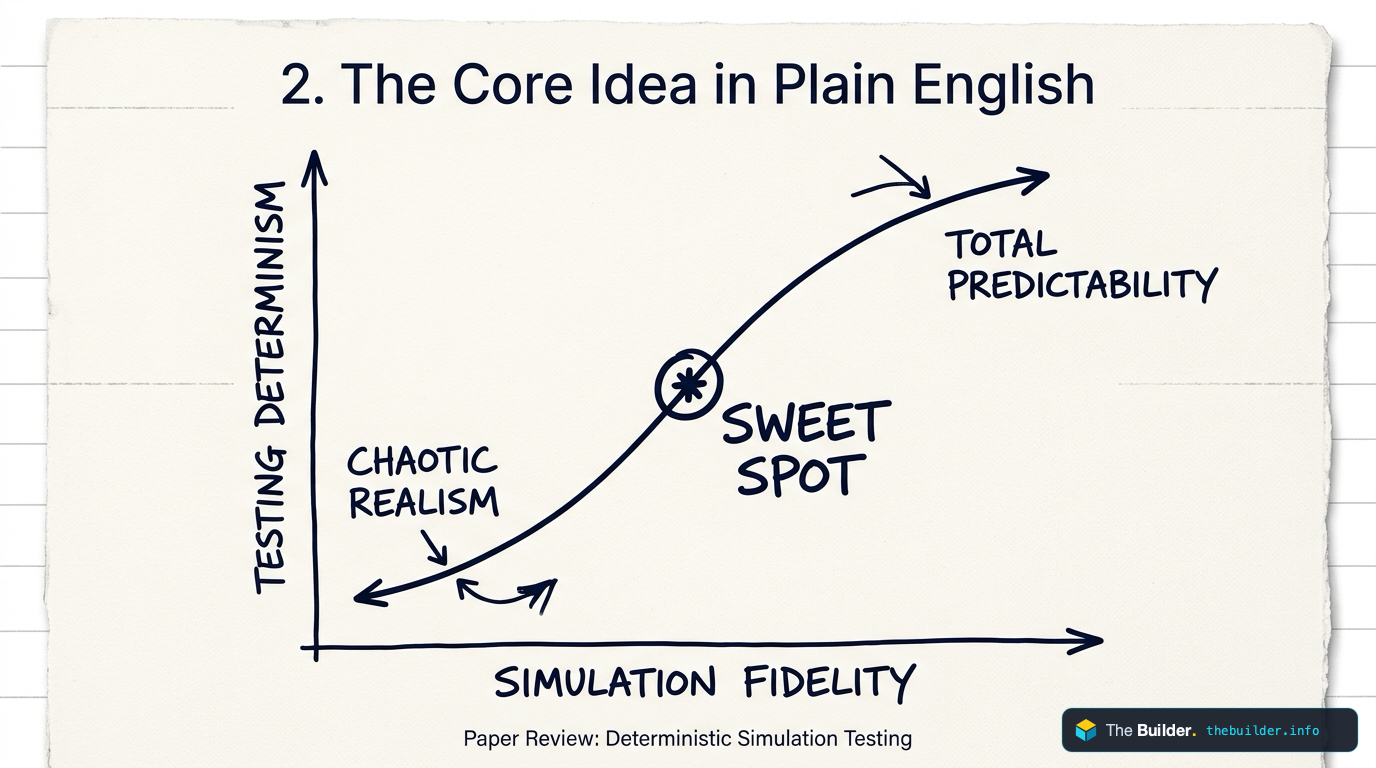
The core insight of Deterministic Simulation Testing is that a distributed system is just a set of state machines reading inputs and producing outputs. The only reason a distributed system behaves non-deterministically is because it interacts with the outside world through the operating system: network sockets, disk I/O, system clocks, and thread schedulers.
If you place an abstraction boundary between your application logic and those operating system primitives, you can swap the real OS for a simulated one.
In a DST environment, all nodes of your cluster run inside a single operating system thread. Concurrency is cooperative (using coroutines, futures, or actors) rather than preemptive. At the bottom of the stack sits a deterministic event loop powered by a Pseudo-Random Number Generator (PRNG) initialized with a specific integer seed.
+-------------------------------------------------------+
|              Single-Threaded Simulator                |
|  Seed: 94827104                                       |
|                                                       |
|   +---------+       +---------+       +---------+     |
|   | Node A  |       | Node B  |       | Node C  |     |
|   +----+----+       +----+----+       +----+----+     |
|        |                 |                 |          |
|   ==+    =+    =+ ===   |
|  Deterministic Abstraction Layer (Net, Disk, Clock)   |
|   ==+    =+    =+ ===   |
|        |                 |                 |          |
|   +----+-----------------+-----------------+----+     |
|   |        Simulated Event Queue & Faults       |     |
|   |  - Drop 5% of packets between A and B       |     |
|   |  - Stall Node C disk write for 400ms        |     |
|   |  - Advance virtual clock to next event      |     |
|   +---------------------------------------------+     |
+-------------------------------------------------------+
When Node A sends a message to Node B, it does not touch a Linux TCP socket. It hands the byte buffer to the simulator. The simulator consults its PRNG to decide whether to drop the packet, reorder it, or delay its arrival by 300 milliseconds.
Because there is no real I/O, the simulator does not need to wait 300 real milliseconds. If the next scheduled event in the entire cluster is that packet arriving 300ms later, the simulator immediately jumps the virtual clock forward by 300ms and executes the handler. Time becomes purely logical. A test can simulate ten hours of timeouts, retries, and disk stalls in fifty milliseconds of wall-clock time.
Most importantly, if the test assertion fails after ten million simulated events, you do not need to guess what happened. You take the integer seed (94827104), feed it back into the simulator on your laptop, and the exact same sequence of millions of network drops, clock skews, and disk corruptions will replay instruction-for-instruction. You can attach a debugger and step right up to the moment of corruption.
3. Where the Assumptions Hold vs. Break in Production
Deterministic simulation feels like a superpower, but it is not free. It requires strict architectural discipline, and it has sharp edges where the simulation diverges from production reality.
Where it holds:
Protocol and state machine verification: Consensus algorithms (Raft, Paxos, Viewstamped Replication), transaction coordinators, and storage engine recovery loops benefit massively from DST. These components suffer most from complex interleavings of partial failures.
Time compression: Bugs that depend on long wall-clock horizons, like lease expirations intersecting with garbage collection pauses, become trivial to trigger when the simulator can warp time.
Where it breaks:
Leaky abstractions and third-party dependencies: You cannot easily drop an off-the-shelf C library, a standard database driver, or the Go runtime into a deterministic simulator. If a library spawns an OS thread, reads /dev/urandom, iterates over a hash map with randomized seed ordering, or checks gettimeofday(), determinism breaks. FoundationDB had to build a custom actor language (Flow) that compiles to C++. Rust teams using the turmoil or madsim crates must carefully audit their dependency trees to ensure everything binds to the mocked tokio runtime.
Performance and tail latency blind spots: Because DST skips over idle time and mocks disk/network latency with probability distributions, it tells you nothing about real hardware performance. A system can pass a billion simulation cycles and still melt down in production because of Linux kernel lock contention, NUMA node thrashing, or SSD garbage collection spikes that your statistical fault model did not accurately capture.
Retrofitting cost: You cannot easily bolt DST onto an existing five-year-old microservice architecture. It almost always requires designing the system around the simulation boundary from day one, or committing to a complete rewrite of the I/O layer.
4. One Thing I Would Steal (or Test This Weekend)
You do not need to rewrite your entire stack in a custom actor framework to get value from this paper. The most practical pattern to steal immediately is dependency-injecting the clock and random number generator in your core state machines.
This weekend, pick one stateful component in your codebase, such as a rate limiter, a retry queue, or a cache invalidator. Strip out every direct call to time.Now(), Thread.sleep(), and global random number generators. Replace them with an injected Environment interface:
type Environment interface {
    Now() time.Time
    Sleep(d time.Duration)
    RandIntn(n int) int
}
In your unit tests, pass in a SimulatedEnvironment backed by a seeded PRNG and a manual integer counter for time. Write a property test that runs a loop of 10,000 random operations against your component, advancing the fake clock by random intervals and checking invariants at the end. You will not have a full network simulator, but you will immediately flush out off-by-one boundary bugs in your timeout and expiration logic.
5. Citation & Primary Link
Source: Phil Eaton (published on MartinFowler.com), Deterministic Simulation Testing (2024), drawing heavily on Will Wilson's Strange Loop talk Testing Distributed Systems w/ Deterministic Simulation (FoundationDB) and Joran Dirk Greef's work on TigerBeetle.
Primary Link: https://martinfowler.com/articles/deterministic-simulation-testing.html
***
Peer Question: For those who have tried introducing deterministic clock or network abstractions into existing production services, where did your abstraction boundary leak first: third-party SDKs, language runtime scheduling, or sneaky state hidden in memory addresses and hash map iteration orders?


Comments