

Paper Review: Towards a Science of AI Agent Reliability (arXiv:2602.16666)

Why 99% accuracy on static benchmarks still fails high-consequence reliability bars, and how to measure calibration and failure containment.
1. Why This Paper Matters Now
If you build distributed systems, you learn early on that averages lie. A service with 99% uptime is down for three and a half days a year. A database with a 1 millisecond average latency might still take four seconds at the 99.9th percentile, stalling every downstream queue in your architecture.
Yet when we evaluate AI agents today, we almost exclusively look at averages. We run an agent against a static benchmark, see that it solves 88% or 95% of the tasks, and declare it ready for production.
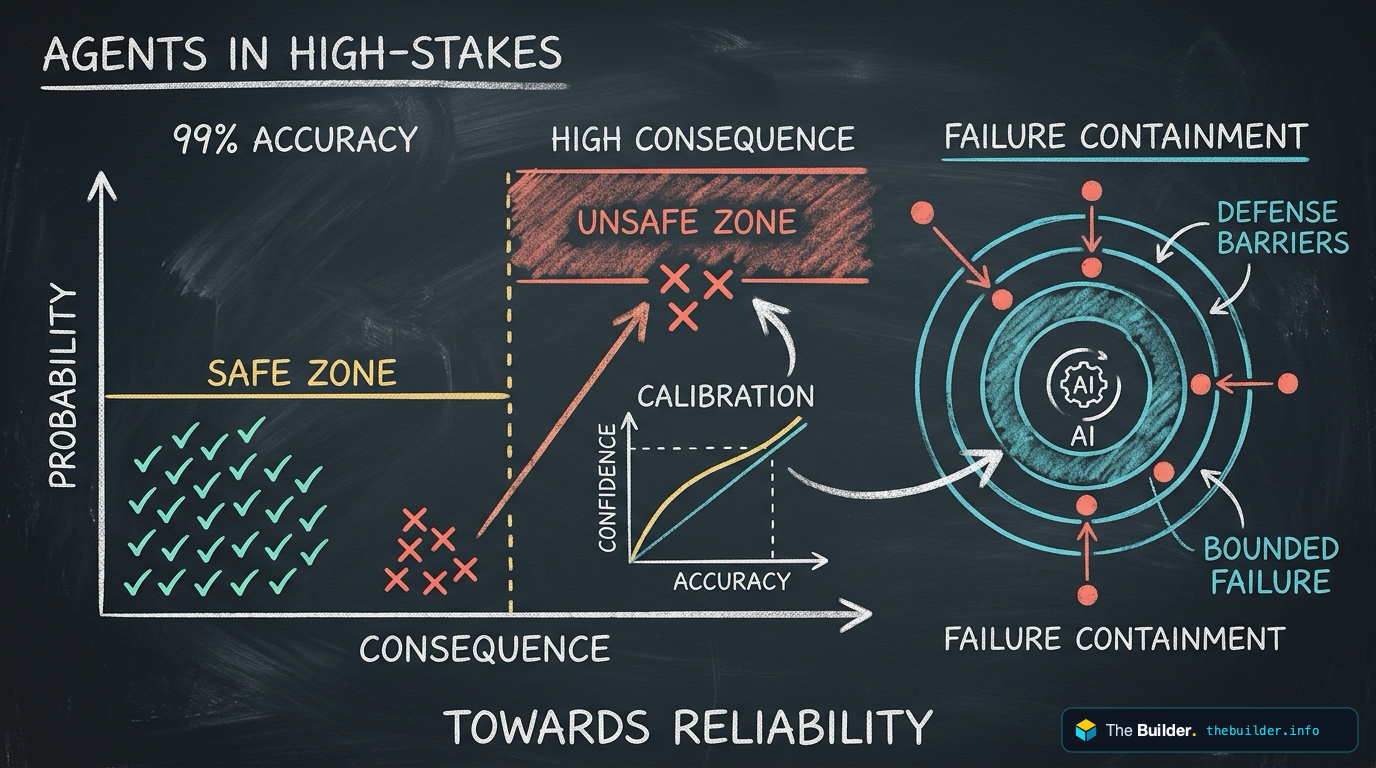
Then we put it in front of real APIs and real state. Suddenly, a 99% per-step accuracy rate compounds over a 30-step workflow into a 26% end-to-end failure rate. Worse, when the agent fails, it does not just return a clean HTTP 500. It hallucinates a parameter, retries a non-idempotent billing call, or corrupts a customer record while reporting high confidence.
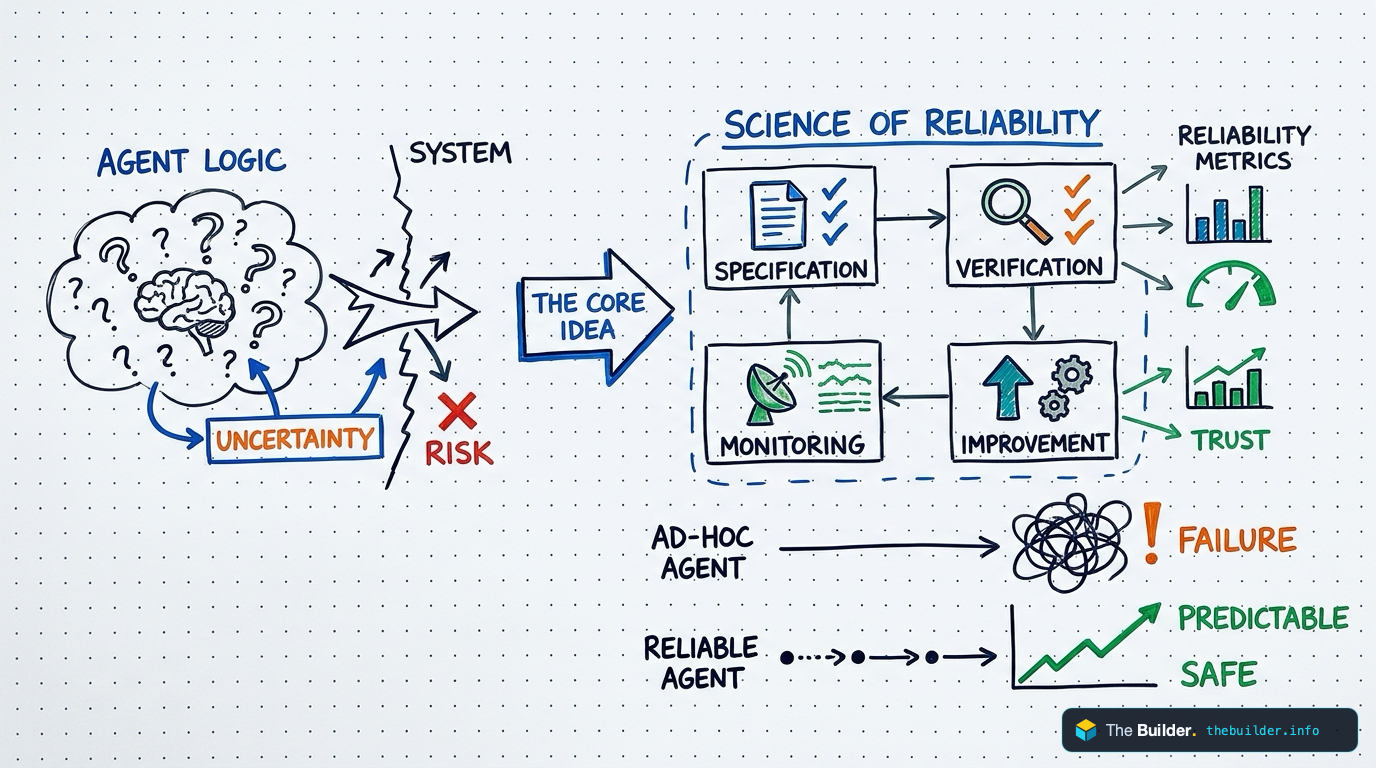
Rabanser et al.'s February 2026 paper, Towards a Science of AI Agent Reliability, tackles this exact gap. The authors argue that benchmark accuracy measures capability, not reliability. If we want to deploy agents in high-consequence environments, we have to stop treating them like students taking a multiple-choice test and start treating them like faulty nodes in a distributed system.
2. The Core Idea in Plain English
The paper strips away the hype around "autonomous reasoning" and proposes a systems engineering framework for agent evaluation. Instead of asking "How often does the agent get the right answer?", the authors ask two much more useful questions:
Calibration: Does the agent know when it is about to fail?
Failure Containment: When it does fail, what is the blast radius?
In traditional software, we use circuit breakers, timeouts, and strict type schemas to contain failure. With an LLM-backed agent, the state space is unbounded, and the failure modes are semantic rather than syntactic. The authors introduce a formal way to model an agent's trajectory through a task not as a single prompt-response pair, but as a state machine with probabilistic transitions.
They break agent reliability down into three measurable pillars:
Stepwise Uncertainty Calibration: At every tool call or state transition, the system extracts a confidence score (via token log-probabilities, self-consistency sampling, or a lightweight verifier). A well-calibrated agent has confidence scores that match its actual empirical success rate.
Monotonic Risk Accumulation: Because errors compound across steps, the system tracks a running "risk budget" for the trajectory. Even slightly uncertain steps deplete this budget.
Bounded Containment Envelopes: Before an agent can execute a state-mutating action (like writing to a database or sending an email), its current risk budget and step calibration must pass a deterministic gate.
Here is how the paper's architecture looks in practice, stripped of the math:
[Agent State S_t]
       |
       v
(Propose Action A_t + Confidence C_t)
       |
       v
+-----------------------------------------+
| Deterministic Reliability Envelope      |
| 1. Is C_t > Threshold(Action Severity)? |
| 2. Is Cumulative Risk < Budget?         |
| 3. Is A_t reversible / idempotent?      |
+-----------------------------------------+
       |                        |
      YES                       NO
       |                        |
       v                        v
[Execute Tool]         [Halt / Escalate / Rollback]
The brilliance here is separating the probabilistic planner (the LLM) from the deterministic safety harness. The paper demonstrates that while you cannot force a frontier model to be 99.999% accurate on open-ended tasks, you can build an envelope around it that catches 99.9% of catastrophic state mutations before they hit the wire.
3. Where the Assumptions Hold vs. Break in Production
This paper is a breath of fresh air because the authors clearly understand real-world failure modes. However, translating their framework into a high-throughput production environment exposes a few sharp edges.
Where the assumptions hold: The math around compounding error rates is spot on. In production, multi-step agents rarely fail on the first turn; they drift slowly off course after step five or six when tool outputs return unexpected edge cases. Tracking cumulative uncertainty across a session is a remarkably effective way to kill zombie trajectories early, saving both token costs and downstream API load.
Where the assumptions break: First, calibration latency at the tail. To get reliable uncertainty estimates, the paper relies heavily on multi-sample consensus (generating $K$ possible next steps and measuring semantic agreement) alongside verifier models. Doing this at every step of a 15-step workflow destroys your P99 latency and multiplies your inference bill by $K$. If you are running an asynchronous background job, that is fine. If a user is waiting on a synchronous UI response, it is a non-starter.
Second, the myth of clean rollbacks. The containment model assumes we can cleanly classify actions into "reversible" and "irreversible," and rely on rollbacks when a multi-step trajectory goes sideways. Anyone who has built distributed sagas knows that compensating transactions are leaky abstractions. Once an agent reads sensitive data into its context window, or triggers a third-party webhook, you cannot simply run an UNDO command. State boundaries in production are messy, and external side effects are permanent.
Finally, correlated failures in verifiers. If your primary agent and your calibration verifier are both fine-tuned from the same base model family, they will share blind spots. When the agent hallucinates with high confidence due to an out-of-distribution input, the verifier often nods right along with it.
4. One Thing I Would Steal (or Test This Weekend)
If you have an agent running in production today, steal the paper's Severity-Weighted Calibration Matrix and implement it as middleware on your tool-execution layer.
Do not bother with multi-sampling every step yet. Instead, take two hours this weekend to tag every tool in your agent's registry with a static blast-radius tier:
Tier 0: Read-only, idempotent, public data (e.g., search docs).
Tier 1: Read-only, sensitive/PII data, or scoped scratchpad writes.
Tier 2: State-mutating, reversible (e.g., create draft ticket).
Tier 3: State-mutating, irreversible (e.g., refund charge, delete record).
Next, log the log-probabilities of the tool-call tokens your model generates alongside the tool tier. Run your existing evaluation suite or shadow-test against production traffic, and plot a simple reliability diagram: when the model calls a Tier 2 or Tier 3 tool, what do the token probabilities look like on the calls that failed versus the calls that succeeded?
You will quickly find a clean threshold where forcing a human-in-the-loop escalation or a deterministic schema check eliminates 80% of your worst production incidents with near-zero impact on P99 latency.
5. Citation & Primary Link
Paper: Towards a Science of AI Agent Reliability
Authors: Stephan Rabanser et al. (Feb 2026)
Direct PDF: https://arxiv.org/pdf/2602.16666.pdf
***
A question for peers building agentic workflows: How are you currently measuring and bounding the blast radius of multi-step tool calls in production, and have you found a way to compute step-level calibration without blowing up your P99 latency budget?


Comments